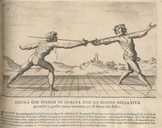
 A plate from Capo Ferro's Treatise
 Curating information is a task that demands that one think carefully about how various types of material are being presented.
As some of you may have noticed, I recently started working on a page of Stage Combat Resources for this site, as I feel that there is a need for such a thing. (I also started a more modest one for Playwriting & Dramaturgy, but that is more to guide people to the more established resources that are already out there). On the stage combat page I've listed (among other things): links to professional organizations, weapons suppliers that I can vouch for, some teaching organizations in NYC that I've trained with, and links to a bunch of stuff by & about me (including my recent McSweeney's interview, which I have to admit made me feel mildly famous). And perhaps most importantly, a selected bibliography.
The bibliography is where I am having some trouble. While books by B.H. Barry and J. Allen Suddeth are obvious and required reading, I don't quite know what to do with Ridolfo Capo Ferro. Or Vincentio Saviolo. Or Morihei Ueshiba for that matter. Let me explain...
As some of you may have noticed, I recently started working on a page of Stage Combat Resources for this site, as I feel that there is a need for such a thing. (I also started a more modest one for Playwriting & Dramaturgy, but that is more to guide people to the more established resources that are already out there). On the stage combat page I've listed (among other things): links to professional organizations, weapons suppliers that I can vouch for, some teaching organizations in NYC that I've trained with, and links to a bunch of stuff by & about me (including my recent McSweeney's interview, which I have to admit made me feel mildly famous). And perhaps most importantly, a selected bibliography.
The bibliography is where I am having some trouble. While books by B.H. Barry and J. Allen Suddeth are obvious and required reading, I don't quite know what to do with Ridolfo Capo Ferro. Or Vincentio Saviolo. Or Morihei Ueshiba for that matter. Let me explain...
Cappo Ferro is the author of a well known treatise on dueling. If his name sounds familiar, it's because he is referenced (along with other luminaries) in the famous sword fight between Inigo Montoya and the Man in Black in The Princess Bride. Those masters and manuals that the characters reference are not about pretending to fight for the sake of an audience, they are about actually fighting.
Many very important figures in the world of stage combat include fencing manuals in their bibliographies, and many scholars whom I respect include such manuals in their bibliographies as "stage combat books." I have some issues with this.
I feel that there need to be disclaimers on the realities (or perceived realities) that we reference. Or in other words, Renaissance fencing manuals, while they are amazingly valuable resources for fight directors, are in fact essentially instruction manuals on how to kill someone with a sword. And in my opinion should not be grouped with books about creating safe and effective choreography for the stage. The same is true for any choreography adapted from martial arts with living traditions. Someone might make a brief study of Aikido or Shorin-Ryu Karate for the sake of researching a fight scene, but they should not conflate martial arts training and theatrical fighting.
That said, it is extremely valuable for those who create fights for the stage and screen to be aware of these books. We reference the realities of violence to some degree or another, we do not recreate them. Knowledge of various fighting disciplines can expand the choreographic palette, but the source material must be recognized for what it is. Any time that techniques are adapted from such source material they are of course modified to make them safe for actors to perform as well as dramatically effective for the sake of the story being told.
I have a fairly substantial list of martial arts, self defense, and military manuals in the bibliography of my dissertation. I would love to make portions of this list available to other people in the stage combat world. But I am not yet sure how to contextualize them. The writings of Marc MacYoung, for instance, while giving a whole lot of perspective and context for portraying violence, have little to do with creating entertainment in and of themselves. And if/when I group his work with similar material as a resource for stage combat, it will be in a very different context than I would if I were presenting the same information for martial artists (though there is some overlap between martial artists and fight directors).
One of the larger questions I deal with in my scholarship is the relationship between real and simulated violence. What should be the place of 17th century fencing manuals for those people who deal with the creation of fake violence for the sake of storytelling? I'm sure I'll be expanding the resources page soon to include resources that are not inherently related to the stage, so the question is how they should be contextualized.
EDIT (3/16/2012): My list of Martial Arts Resources for Stage Combat can be found by clicking here.
 RSS Feed