Picture
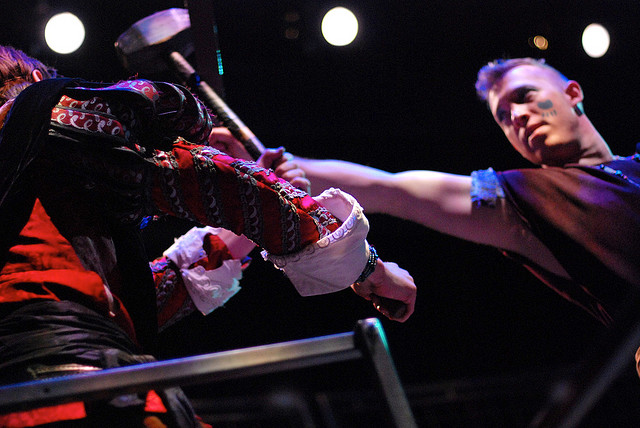
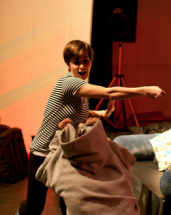
PETER PAN @ Tufts University - Photo by Elizabeth Herman
Attention Young Actors:  You don't always know what you think you know. This is especially true when it comes to stage combat.  And you may want to think twice before you claim it on a resume.  This is true even if you took a workshop or two and/or performed fights onstage a handful of times.

I'm talking mostly about the "Special Skills" section of the resume.  As many of you know, common wisdom dictates that you should not put anything down on there that you cannot do on short notice.  I want to work on the assumption that people are making their claims in good faith (liars are a whole other issue).  That one would not put down a language that they do not speak, an instrument they do not play, or claim a degree that they have not earned.


But unfortunately, sometimes stage combat ends up on an acting resume when it really shouldn't be...


It is a dark, dark world that we whistle in...


Picture
Not very long ago I shot an abuse-prevention training video/PSA at Triangle Inc with Ablevision as part of their new IMPACT: Ability program.  

The last time I acted on camera was a little over a year ago for Malarkey Films, which in turn was the first time I'd done that in several years.  That shoot involved a stuffed monkey puppet and a gas mask.  This project however, had a significantly more serious tone.

It was great to be a performer again, as very few other arts have the same degree of immediate gratification.  I had almost forgotten how fun it is.

This however, was not a typical shoot...


Picture
A plate from Capo Ferro's Treatise
Curating information is a task that demands that one think carefully about how various types of material are being presented.

As some of you may have noticed, I recently started working on a page of Stage Combat Resources for this site, as I feel that there is a need for such a thing.  (I also started a more modest one for Playwriting & Dramaturgy, but that is more to guide people to the more established resources that are already out there).  On the stage combat page I've listed (among other things): links to professional organizations, weapons suppliers that I can vouch for, some teaching organizations in NYC that I've trained with, and links to a bunch of stuff by & about me (including my recent McSweeney's interview, which I have to admit made me feel mildly famous).  And perhaps most importantly, a selected bibliography. 

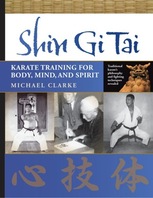
The bibliography is where I am having some trouble.  While books by B.H. Barry and J. Allen Suddeth are obvious and required reading, I don't quite know what to do with Ridolfo Capo Ferro. Or Vincentio Saviolo.  Or Morihei Ueshiba for that matter.  Let me explain... 


Picture
This past November I was one of two alumni speakers at TEX: Tufts Idea Exchange.  TEX is an event inspired by and modeled on TED.  If you are not familiar with TED, do yourself a favor and click that link.  Be sure that you don't have anyplace important to be for a while. 

I'm coming back to this long-overdue post now in part because I've noticed through social media that they're soliciting speakers again, and to urge anyone among my readership in the Tufts community to apply.  And also, anyone with access to any similar events, like TEDx for instance, to make a point of going and/or somehow getting involved.  (I met many of the people involved in TEDxSomerville, and they are awesome, one of the TEX presenters will actually be speaking at their event).  For something even more informal, check out NerdNite

I want to talk specifically about TEX, and generally about what events like this have to offer.  Let's start with my presentation and go from there...


Picture
A few weeks ago I wrote at some length about the general utility of studying stage combat.  I touched on the subject of falls at the time, but I'd like to go into it in a little more depth here.  As I've said before, falls are a surprisingly high risk activity on stage, in part because in many circumstance performers do not even realize that they are at risk.  Many are surprised to learn that they constitute an important part of stage combat training.  It doesn't take a whole lot of thought to realize why falls are both so important (because you can hurt yourself on the way down to the ground in myriad ways) and so often overlooked (because they are so obvious). 

Before going much further I need to acknowledge that there are written sources on falls from fight directors far more advanced than myself.  By way of example, an excellent technical manual is Combat Mime: A Non-Violent Approach to Stage Violence by J.D. Martinez, is one of the standard texts on unarmed combat and a book I strongly recommend for anyone pursuing any long-term study of physical performance.

Anyway, let's talk a bit about falling on stage or screen.  (Like some of my other posts, this is probably an early draft of something that I'll expand into a more in-depth article or paper later on.)


"Professional Fight Director and Stage Combat Instructor" is apparently one of the best jobs one can possibly have when attending a cocktail party (though for the record, I would like to state that I always say "Playwright" first).  A surprising amount of intelligent and educated people are unaware that the job actually exists.  And once they do know, there is a lot of curiosity about how our work is done.

Recently I've been teaching a whole lot of Intro to Stage Combat workshops in various settings, and I have a few more coming up in the near future.  I've been saying for quite some time that the basics of stage combat are essential skills for actors, as well as incredibly useful for other disciplines within theatre & film.  I would also say that taking such a workshop could also be a really interesting adventure for those outside of professional entertainment. 

I've written a whole lot about this subject  (a dissertation and several articles) and have been the subject some interviews and so on in this capacity as well, so some of what I'm saying here I've said before, but anything I'm repeating is worth writing about again.

The first priority of a fight director is the safety of the performers.   For a profession with such a badass reputation, the practitioners spend a whole lot of time and energy being concerned with the well-being of everyone involved. 

Stage combat has more in common with a combination of ballroom dance and stage magic that it does with any actual fighting discipline.  Once an illusion is decided upon, it becomes a matter of figuring out how to best execute it within the skill level of the cast and in the time allotted.  This can be as "simple" as someone being slapped and/or falling down, or as complex as a duel to the death with chainsaws.  The illusion must also further the story being told and support character development.  If the fight director has done their job well it should be nearly impossible to determine where the director's work ended and where the fight director's has begun.

I'd like to take a moment to discuss why the the study of stage combat is important and why acquiring some familiarity with the skills involved in portraying violence in performance should be given some priority across the various disciplines.        


    "Be well versed in the arts of pen and sword."  -  Miyamoto Musashi, The Book of Five Rings

I recently joked that on principle,  scholars of John Milton and Paradise Lost should all skydive.  In part because the opportunity to fall screaming from Heaven like Lucifer himself would be wonderful fieldwork.  And also because the study of great literature should be visceral.

This was because not so long  ago I went skydiving to celebrate my graduation from my doctoral program, and also because lately I've been having more and more realizations about what I've come to call "fightaturgy," or, the dramaturgical revelations of the analysis of violence and movement implied in a performance text and their effect on character development in a play.  I brought this up in a recent conversation with my friend and colleague Ryan Hartigan, which led me to realize that I need to write about this if I'm going to keep talking about it. 

A few of my current projects have some great examples:


I'm posting here to put down some early thoughts about how stage combat that occurs "in quotes" is choreographed and perceived.  Somewhere down the line I'll be expanding these thoughts into an academic paper. 

About a week ago I came into rehearsal for Whistler in the Dark's production of Tom Stoppard's Dogg's Hamlet, Cahoot's Macbeth, for which I am composing violence.  Both sections of the script involve a play-within-a-play, (Hamlet and Macbeth, respectively).   In one case it is a group of schoolboys putting on Hamlet at their school, in the other it is famous actors putting up an illicit performance of Macbeth in someone's home in a totalitarian regime.  Both metatheatrical sections include the famous duels of the Shakespeare plays that their characters are putting on.  Which means we are seeing an actor playing one character, who is in turn playing another character, who is in turn engaging in a duel.  The task of a fight director in a case like this is not to choreograph the character of Hamlet per se, but to choreograph a schoolboy playing Hamlet.  The character of Hamlet is an early-modern image of a Danish prince who would have had extensive training and familiarity with dueling.  In a production of said play with professional actors, the fight director would be working to articulate the conflict of the duel within these (and other) parameters.  The character in Dogg's Hamlet however, is a schoolboy playing said prince, which adds a whole other filter to the physicality of the fights.  The movement must be believable for a schoolboy moreso than for a prince.  And of course must remain safe for the actors, engaging for the audience, and continue to advance the story.
 
 
This past weekend I attended two seminars taught by Rory Miller.  Rory is the author of Meditations on Violence, and more recently, Facing Violence, both of which are among the best books I've read on the subject (and both of which I ended up citing quite a bit in my dissertation).  In this post I'll be discussing some of his teaching and methodology as well as some of the implications.  I'm responding from the perspective of a theatre and performance scholar who specializes in the representations of violence as much as from the perspective of a martial artist, self defense instructor, and fight director.