Picture
This past November I was one of two alumni speakers at TEX: Tufts Idea Exchange.  TEX is an event inspired by and modeled on TED.  If you are not familiar with TED, do yourself a favor and click that link.  Be sure that you don't have anyplace important to be for a while. 

I'm coming back to this long-overdue post now in part because I've noticed through social media that they're soliciting speakers again, and to urge anyone among my readership in the Tufts community to apply.  And also, anyone with access to any similar events, like TEDx for instance, to make a point of going and/or somehow getting involved.  (I met many of the people involved in TEDxSomerville, and they are awesome, one of the TEX presenters will actually be speaking at their event).  For something even more informal, check out NerdNite

I want to talk specifically about TEX, and generally about what events like this have to offer.  Let's start with my presentation and go from there...


Picture
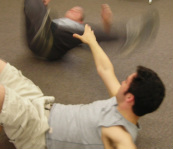
A few weeks ago I wrote at some length about the general utility of studying stage combat.  I touched on the subject of falls at the time, but I'd like to go into it in a little more depth here.  As I've said before, falls are a surprisingly high risk activity on stage, in part because in many circumstance performers do not even realize that they are at risk.  Many are surprised to learn that they constitute an important part of stage combat training.  It doesn't take a whole lot of thought to realize why falls are both so important (because you can hurt yourself on the way down to the ground in myriad ways) and so often overlooked (because they are so obvious). 

Before going much further I need to acknowledge that there are written sources on falls from fight directors far more advanced than myself.  By way of example, an excellent technical manual is Combat Mime: A Non-Violent Approach to Stage Violence by J.D. Martinez, is one of the standard texts on unarmed combat and a book I strongly recommend for anyone pursuing any long-term study of physical performance.

Anyway, let's talk a bit about falling on stage or screen.  (Like some of my other posts, this is probably an early draft of something that I'll expand into a more in-depth article or paper later on.)


"Professional Fight Director and Stage Combat Instructor" is apparently one of the best jobs one can possibly have when attending a cocktail party (though for the record, I would like to state that I always say "Playwright" first).  A surprising amount of intelligent and educated people are unaware that the job actually exists.  And once they do know, there is a lot of curiosity about how our work is done.

Recently I've been teaching a whole lot of Intro to Stage Combat workshops in various settings, and I have a few more coming up in the near future.  I've been saying for quite some time that the basics of stage combat are essential skills for actors, as well as incredibly useful for other disciplines within theatre & film.  I would also say that taking such a workshop could also be a really interesting adventure for those outside of professional entertainment. 

I've written a whole lot about this subject  (a dissertation and several articles) and have been the subject some interviews and so on in this capacity as well, so some of what I'm saying here I've said before, but anything I'm repeating is worth writing about again.

The first priority of a fight director is the safety of the performers.   For a profession with such a badass reputation, the practitioners spend a whole lot of time and energy being concerned with the well-being of everyone involved. 

Stage combat has more in common with a combination of ballroom dance and stage magic that it does with any actual fighting discipline.  Once an illusion is decided upon, it becomes a matter of figuring out how to best execute it within the skill level of the cast and in the time allotted.  This can be as "simple" as someone being slapped and/or falling down, or as complex as a duel to the death with chainsaws.  The illusion must also further the story being told and support character development.  If the fight director has done their job well it should be nearly impossible to determine where the director's work ended and where the fight director's has begun.

I'd like to take a moment to discuss why the the study of stage combat is important and why acquiring some familiarity with the skills involved in portraying violence in performance should be given some priority across the various disciplines.        


As both the Muppets and Shakespeare are on many people's minds these days for various reasons (especially with the new movie about to be released), I thought I'd share a classroom exercise that I've used at both Tufts and Emerson that uses our furry friends to articulate the effects of casting choices on the execution of a play.

It goes like this: