Picture
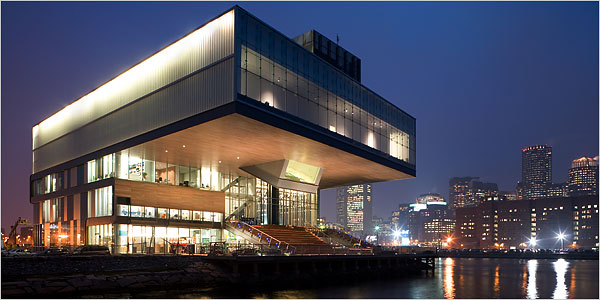
The ICA in Boston, MA
This past weekend I had the pleasure of performing in Experiment America 2012 at the ICA (Institute of Contemporary Art) in Boston.  My director was Mikhael Tara Garver and the event was part of the Emerging America Festival.  

During this process I also had the opportunity to work closely with Will Pickens, the sound designer and voice director, who directed and recorded me in an A Brief Guide, an "audio tour" written by Jason Gray Platt, as well as with Jeff Stark, who guided me through the suitcase installations (more on those later on).

Experiment America was a large immersive theatre experience  utilizing the entire museum.  It was a big project.  Really big.  The sort of thing that falls under Richard Schechner's concept of Performance of Magnitude; that is, a performance that is too large for any one spectator to experience the entirety of.  Keeping that in mind, I cannot hope to describe the event as a whole.  My own small part, however, was interesting and fun enough to give me plenty to write about.



It is a dark, dark world that we whistle in...


Picture
Not very long ago I shot an abuse-prevention training video/PSA at Triangle Inc with Ablevision as part of their new IMPACT: Ability program.  

The last time I acted on camera was a little over a year ago for Malarkey Films, which in turn was the first time I'd done that in several years.  That shoot involved a stuffed monkey puppet and a gas mask.  This project however, had a significantly more serious tone.

It was great to be a performer again, as very few other arts have the same degree of immediate gratification.  I had almost forgotten how fun it is.

This however, was not a typical shoot...


Picture
Graphic by Alison McDonough
Last month I had the pleasure of having a public staged reading of my new full-length play, Burning Up the Dictionary, performed with Vagabond Theatre Group.  This took place at Trident Booksellers & Cafe as part of their "There Will Be Words" reading series.  

Before I say much more I do have to point out that I was very amused to have a play that's largely about language appear in a series called "There Will Be Words." 

Readings are a step in the development of a new play.  I once discussed this process with a computer programmer friend and we realized that we had something significant in common: neither playwrights nor programers really know what they've done until they get to see it running.  The staged reading is a sort of a test run of a play wherein the writer can figure out what changes they intend to make as the work evolves.

This was the first time I've heard the play in its entirety in front of an audience.  I did have the privilege of a table reading of an earlier full draft at the Lark Play Development Center this past November (which I blogged about here) and I got to hear a chunk of it at a Small Theatre Alliance reading back in September (which I also blogged about) after earlier development through Playwrights' Commons' Summer Playground.  All three were really useful experiences, and the script has come a long way because of them, but this last piece was a larger step as it was an opportunity for me to evaluate the current (more advanced) draft under more public conditions and figure out what to do with it next.


Picture
I recently had the pleasure of seeing a reading of Motti Lerner's At Night's End as presented by Israeli Stage.   This was one of the most profound theatrical commentaries of the long term effects of war on individuals, families, and society at large that I have seen in a very long time.  The structure of the piece reminded me quite a bit of the work of Eugene O'Neill, though the translation and direction somehow managed to maintain the rhythms of Israeli Hebrew.  The playwright was there to take questions and comments (I understood that the play itself is still in development).

The play is set in Haifa during the recent Lebanon war and rockets and shelling are a constant factor.  At the center of the play was a very powerful and disturbing portrayal of Post-Traumatic Stress Disorder (PTSD). 

The subject matter has great relevance to our own society right now with so many American soldiers returning from wars overseas.

I hope to see a full production of this play in the near future. We see so much of Israel on the news, and yet for a country that is in our public consciousness so much, we as Americans do not get a whole lot of exposure to Israeli arts. 


I've been thinking a lot lately about the relationships between social media, online marketing, and live performance.  I use the plural because the internet is now a broad enough topic that the relationship between say, twitter and audience development is very different than the phenomenon of critics with blogs, which again is very different from online ticket sales, which is again not in the same universe as online script sales and licensing.  On top of this, we now have the phenomenon of active audience participation through smartphones in some performances, as well as some theatres now having a "twitter section" where audiences are welcome to use smartphones to tweet their experiences as they're happening.  (There has recently been a whole lot of discussion on this phenomenon, my feelings on it are mixed and I am waiting to see what comes of putting this policy into effect.)

Now, some of you who know me as a scholar know that one of my major research interests is the entrepreneurial imperative of the American artist, or, in more plain English: the business of being an artist.  A great deal of the business end of things is now happening online.

What follows are some (very) loosely organized thoughts on the relationships between the theatre community and the internet.  (I may expand on specific segments of this post at a later date.)
 
 
Picture
Over the past few weeks I've found myself in the position of being asked by college students and recent graduates how to get started with working in theatre in Boston.  And in the very recent past I was elected to the board of the Small Theatre Alliance of Boston, which is a position I sought out in part so that I could work on university outreach.  As someone who frequently has a part in training young artists on how to make theatre, I feel it's also important to talk to them about where to make theatre beyond the confines of the academy. 

This is basically what I tell people about working in Boston...


This past Monday I took part in a  Small Theatre Alliance of Boston Open Mic Night at the Charlestown Working Theater.   I brought in a section of a new full length play I'm working on called Burning Up the Dictionary, which I'm billing as "a story of language, love, lust and loss."  I'll be having a round table of the entire thing at the Lark Play Development Center in New York City next month, so this was a great opportunity to test-drive a section of it in front of an audience and see how things play in front of an audience as I work on it in preparation for the Lark.  I've been developing it through the Playwrights' Commons/Company One Playwrights' Playground this past summer (which was quite a blessing), but this was the first time I'd heard it in front of an audience as opposed to workshop participants.